jorge bascoy
A letter to Jorge:
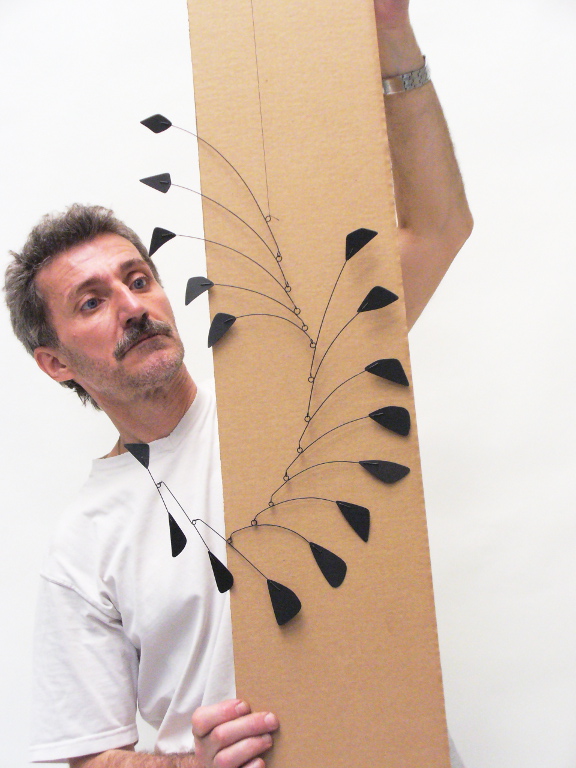
Eight years ago, I moved from Florence to Buenos Aires for good. My house, located in the Palermo Hollywood neighborhood, was ready - an old chorizo style dwelling, renovated and expanded according to my needs, in a modern architectural and design style.One day, while walking through a still unfamiliar neighborhood, I stumbled upon a great display window through which I recognized something familiar. Colored mobiles... Next to the window, stood a large, closed iron door. Nothing was written anywhere. Dying of curiosity, I couldn’t resist and I rang the bell. After a moment, the large door opened, and from within appeared a man in his forties, wearing a smock covered in colored stains; he had a strong face, brilliant sky blue eyes that seemed to smile, was of medium height and a thin build, and when he said hello, I noted that his hands seemed strong and powerful. I asked him if what I had seen was his work, and if it was for sale. Smiling, he said yes, and he invited me to come in and visit his workshop. I climbed up two steps, passed through a small door, and entering into a great space I almost fainted...
Colored mobiles everywhere; hanging from the ceiling, halfway finished on top of the table, others on the floor… A party of forms and colors above my head, beside my arms, at my feet… It seemed apart from reality… Trying to behave normally, I asked him the price of this and that, and when he told me, it took my breath away. Suddenly I had the desire, almost physical, to buy them all...
These mobiles I had dreamed of having in my house, when I had seen them in New York, Madrid, and in Paris, at a great exhibition in the Museum of Modern Art, a dream coming true. I felt such gratitude for this gentlemen who allowed me to possess something I had always loved and had never been able to buy.
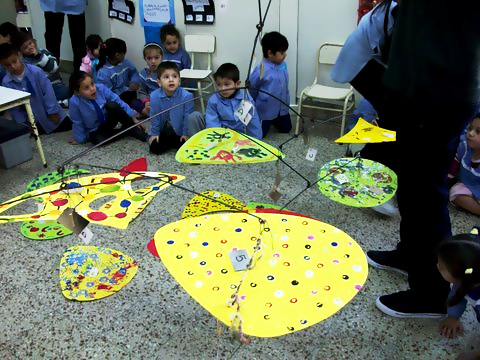 In the end, I bought a large mobile to put above my pool. And that is how a friendship began, one of the dearest that life has given me. Of course once the first mobile I bought from Jorge was hanging above the pool, I then ordered more pieces - three for the side patio, another two for the backyard, and later another and another, and in that way we got to know one other more and more. During which time, I met his beautiful Brazilian wife Raquel, his two sons, Brian and Manuel, who at that time were teenagers, and today are young men who have their parents beautiful faces and strong character - the scientific Brian, and the artistic Manuel. Since Jorge adores coffee, sometimes he would stop by my house to drink Italian coffee and to talk. We’d talk about everything, and we truly enjoyed ourselves chatting and joking in earnest. Although in every respect Jorge has what one would call a professional background, as you can read in his resume, he loves to call himself an artist-architect, like the artists of the Florentine Renaissance. Their "botteghe" were like Jorge’s studio, and they shared the same mentality. They didn't consider themselves artists in the way we consider them today, even though they were great artists, they didn’t see themselves as creators of works “set” and commercialized at exaggerated prices, often without basis, like so many artists of today, but rather part of a group that worked day in and day out; architects who specialized in beauty, who harshly negotiated prices, almost fighting with their clients - the wealthy Florentine merchants, bankers, Lorenzo the Magnificent himself.
 Like those before him, Jorge wakes up very early every morning, at 6 AM, and after drinking his first coffee of the day, walks the few meters from his patio to his studio and begins to work. Like all true artists, he likes to learn with humility, by entering the secret world of the masters, interpreting their works in metal, steel, acrylic, wood; making them with his hands to master their aesthetic wisdom.
His small metal works, all his own, are charming; birds, ducks, elephants, giraffes, peacocks - all magical. His brilliant serpent measuring meters and meters is spectacular; its flowered branches made of metal have the subtlety of the masters of Art Nouveau. His biomorphic forms are trees with many branches and leaves that fuse together with the surrounding landscape, growing along walls, anchored in the earth.
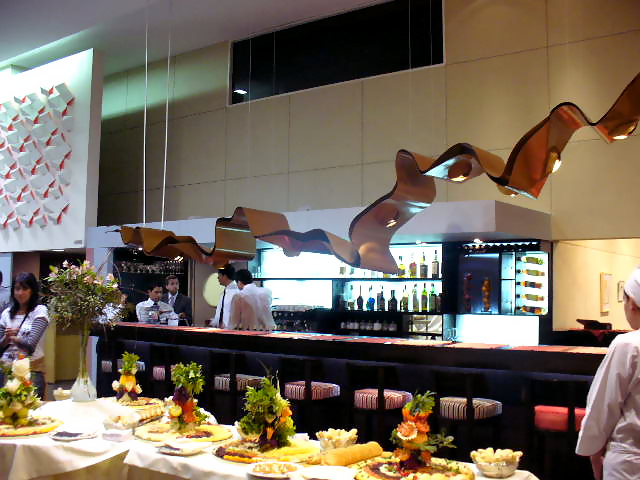 His pieces can be found in houses, apartments, gardens, hotels, banks, offices, museums, and children’s clothing stores; geometric abstractions, symbols, pure colors, segments, and graphs that sail through the air. Duchamp called them Mobiles; Arp called them Stabiles.
 Jorge, artistically speaking, nourishes himself with kinetic art; on the one hand futurism, and on the other Russian constructivism. Jean-Paul Sartre describes this type of work like so, “A general destiny of movement is sketched for them, and then they are left to work it out for themselves; it could be the hour, the sun, the heat, the air that decides the single dance, and so the object stays forever halfway between the statue’s subjugation and the independence of natural events.”
I believe that Jorge, on top of his brilliant, long serpent, that flies with branches covered in colored flowers in his hands, will go very far.
Buenos Aires, August 4, 2013
Your Friend Nilo
